A strange fate
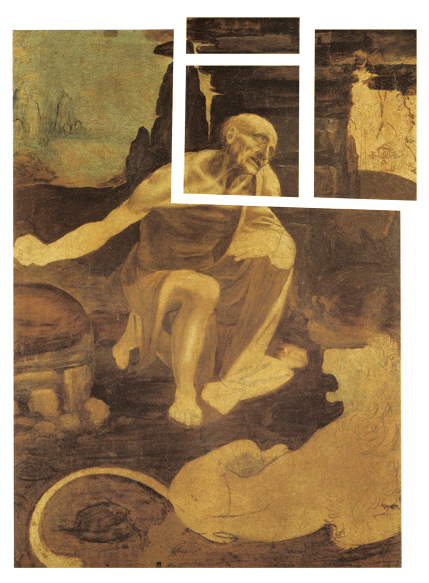
It is well known that this painting was once cut into four pieces.
The image on the left shows the location where the cut was made. Looking at this, it looks like the intention was not to cut the painting into four pieces, but to remove the head of St. Jerome.
However, the severed head part has some incomplete aspects, such as the face being off-center. It does not look like they were planning to use this part for anything. In fact, there are no traces or scratches on the cut painting, including this part, that would suggest it had been used for anything.
Another strange point is why they took the trouble to put the cut parts back together and reconnect them.
According to a report by Gian Luigi Coralucci, who restored the painting, the painting was cut with something like a saw with a very thin blade. Therefore, it seems that it was relatively easy to reconnect the painting to its original state.
It is noteworthy that a saw with a very thin blade was used, and the person who cut the painting was trying to minimize damage to the painting. In other words, it is possible that they cut the painting with the intention of putting it back together from the beginning.
If you ask why they would do such a thing, my answer is to create a story. The person who cut up the painting probably wanted to create a story about it being used as the door of furniture at an antiques shop, or as the top of a shoe repair shop's step stool.
So who would have tried to create such a story? It was the person who first discovered that the painting had been cut up, that is, Napoleon's uncle, Cardinal Joseph Fesch. The truth is probably that there was some inconvenient fact about how the painting was obtained, and such a story was needed to hide that fact.
Either way, I believe that Cardinal Joseph Fesch was deeply involved in the fact that St. Jerome was cut into four pieces.
|
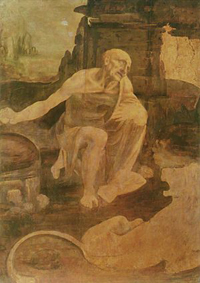
Saint JeromeOil and tempera on walnut, 102.8 x 73.5 cm Rome, Pinacoteca Vaticana
There are several opinions about when this painting was created, but most experts agree that it was created during the First Florentine Period. However, I believe this painting was created much later, during the Milanese Period or later. The reason is that the depiction of St. Jerome's neck and shoulders shows anatomical experience and knowledge not seen in the First Florentine Period. The depiction of the neck in particular is almost at the same level as Judas in The Last Supper, indicating that he had acquired a considerable knowledge of anatomy. In addition, even the right arm, which is not depicted in detail, is depicted only as an outline, but the presence of muscles and bones is fully felt, and I feel that his understanding of the human body has progressed significantly. The depiction of the head also accurately captures the expression of the very thin muscles around the cheeks, and unlike depictions that simply capture the appearance, you can see that he always draws with an awareness of the presence of parts such as muscles and tendons. In contrast, in the Adoration of the Kings, which was painted during the First Florentine Period, there is almost no attention paid to the presence of these muscles, and I feel that the difference in attention when painting figures is quite large. Many experts date this painting of St. Jerome to the First Florentine Period because the overall atmosphere of this painting is very similar to that of The Adoration of the Kings, but this is only the overall atmosphere that is similar, and there are significant differences between the two paintings when you look closely at things like anatomical depictions. Another reason why I believe this painting of St. Jerome is from the First Milanese Period or later is the material of the wooden board used for this painting. This painting of St. Jerome is painted on a walnut board. This point is problematic. During this period, the boards used for paintings differed from region to region, with poplar being used in Florence and walnut being used in Milan. In other words, judging from the board used, this painting was painted in Milan. Judging from the material of the board used and the level of skill in the anatomical depictions, I believe this painting was painted after the First Milanese Period.
|

leonardoresearch.jp